Your team finds that an AI answer recommends three competitors and leaves your brand out. The problem is deciding which evidence to trust, what to change, and who can ship that change.
That is the useful starting point for comparing SEORCE vs. Semrush AI Visibility in 2026. SEORCE presents a connected system for –
- Discovery
- Content
- Technical fixes
- Measurement
Semrush offers a separate AI Visibility Toolkit and also bundles SEO and AI capabilities through Semrush One. Describing Semrush only as a bolt-on misses that second purchase route.
The decision depends on your team’s bottleneck. If execution is slow, investigate SEORCE’s integrated workflow. If you already depend on Semrush research and reporting, test whether its AI tools extend that workflow economically. Neither architectural label establishes which platform will measure your market more accurately or earn more citations.
What “Unified” Should Mean To A Buyer
One invoice makes payments easier, and one platform saves time switching between tools. But a truly useful platform should do more. It should help teams understand a problem, decide what to fix, make the change, and measure the results.
SEORCE’s homepage connects AI Beacon, keyword and backlink intelligence, Content Studio, its technical suite, rank tracking, and analytics. That is a coherent proposition for a team losing time between diagnosis and delivery. It is still a proposition to validate against your website, permissions, and review process.
Semrush’s purchase structure separates its AI toolkit from other capabilities while offering an SEO and AI bundle. Its Prompt Tracking documentation also describes comparing AI results with traditional rankings inside Position Tracking. A separate subscription line therefore does not prove a disconnected workflow.
Use four questions in the demo:
- Can I open the captured answer and inspect the cited pages?
- Can I turn that finding into a specific task without reconstructing the context?
- Can the right person approve and verify the change?
- Can I rerun the same question under comparable conditions afterward?
These questions are deliberately operational. An impressive summary score cannot compensate for a task that arrives without evidence or a fix nobody is allowed to publish.
The Differences That Deserve A Closer Look
| Decision area | SEORCE | Semrush AI Visibility and Semrush One |
| Product approach | Connected discovery and execution platform | Separate the AI toolkit plus an SEO and AI bundle |
| Answer investigation | AI Beacon advertises answer, source, competitor, and diagnosis context | Prompt tracking documents, snapshots, and cited-source reports |
| Content workflow | Content Studio supports briefs, drafting, and editing | Check the exact bundle and any separate content subscription |
| Technical work | The technical suite advertises AutoFix and verification | The AI toolkit includes AI search checks in Site Audit |
| Main diligence question | Can the advertised action workflow work safely on your site? | Do the required reports, domains, and users fit the subscription? |
This is a comparison of documented scope, not a test of output quality. A feature listed in a product overview may have a narrower allowance in your plan.
AI Visibility Needs Evidence Behind The Score
AI Beacon describes tracking brand language, competitor appearances, sources, and stages of buyer intent. Those are useful dimensions: an introductory definition has a different business meaning than a recommendation made during vendor selection. Ask SEORCE to demonstrate the evidence behind a diagnosis, including what it can actually observe versus infer. A cited URL is visible evidence, while a causal explanation for why a model omitted you requires more scrutiny.
Semrush documents several data products with different scopes and refresh schedules. Its methodology distinguishes broad research data, weekly brand performance reporting, daily custom Prompt Tracking, and audits refreshed on a crawl. It explicitly treats visibility metrics as directional signals. Do not read a change in one report as an equivalent change across every report.
Engine Coverage Depends On The Report And The Plan
SEORCE’s AI Beacon page names ChatGPT, Gemini, Perplexity, Claude, Grok, Microsoft Copilot, and Google AI Overviews. Its current pricing table describes a different, tiered engine list. The public pages therefore do not establish one unambiguous engine entitlement for every plan. Get the exact supported surfaces and collection method in writing.
Semrush’s Prompt Tracking setup guide currently lists ChatGPT Search, Google AI Mode, and Gemini, while its data-methodology page also mentions AI Overviews under Prompt Tracking and Perplexity under Brand Performance. Coverage in one report should not be assumed to apply to another. Validate the campaign selector for the engine and country you need.
For a team whose buyers research in a particular assistant, a long platform list is less useful than reliable coverage of that assistant’s relevant experience. Ask whether the tool observes a consumer search interface, an API response, or another collection route. Record location, language, search mode, and capture date wherever available.
Where Execution Changes The Comparison
SEORCE’s strongest reason to investigate is the proposed handoff from a visibility finding to action. Content Studio describes a staged process from brief and keywords to outline, writing, editing, and export. A content lead can examine whether the system preserves the original question and produces something the subject expert can actually approve.
Take a hypothetical integration gap. Buyers ask whether your software works with their accounting system, but your product page only says it has flexible integrations. The useful change is a verified integration page with supported versions, limitations, setup steps, and an owner who will maintain it. A longer article that repeats the same vague claim does not solve the gap.
Technical Suite‘s current page advertises logged changes, before-and-after differences, rollback, and a distinction between automatically applied fixes and issues requiring further work. Its homepage describes a narrower AutoFix scope, including internal links as coming soon, whereas the technical page describes internal-link repair. Treat these differences as demo requirements rather than assuming every advertised action is available in production.
Semrush’s AI tools document competitive gaps, prompt research, sentiment, and source investigation. Those findings can support an existing editorial or engineering workflow; the core AI subscription should not be assumed to include every execution capability elsewhere in Semrush’s catalog. Its feature guide lists content creation in a separate toolkit.
Pricing Without The Misleading Shortcuts
The table below showcases the pricing of both SEORCE and Semrush and what they offer in their respective plans –
| Plan | Advertisedmonthly price | Selected published limits |
| SEORCE Lite | $49 | 1 website; 20 prompts; 2 AI engines |
| SEORCE Starter | $99 | 3 websites; 3 team members; 50 prompts; 3 AI engines |
| SEORCE Growth | $249 | 10 websites; 5 team members; 180 prompts; 4 AI engines |
| SEORCE Agency | $999 | 50 websites; 25 team members; 1,000 prompts; 7 AI engines |
| Semrush Starter | $199 | 5 websites can be monitored, 500 keywords can be tracked daily, keyword search and optimization tools included. |
| Semrush Pro+ | $299 | 15 websites can be monitored, 1500 keywords can be tracked daily, historical SEO data included |
| Semrush Advanced | $549 | 40+ websites can be monitored, 5K keywords can be tracked daily, SEO share of voice |
How To Compare Measurements Fairly
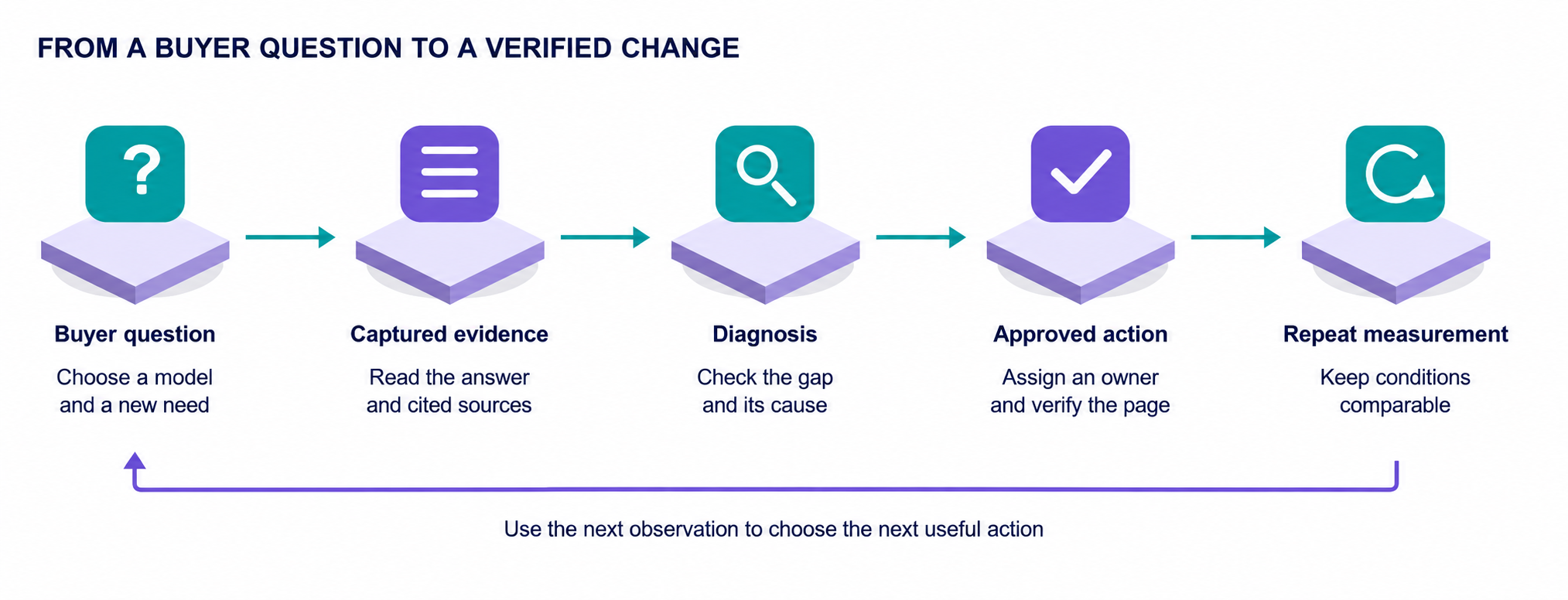
Start with a stable set of buyer questions. Separate discovery questions from requirements, comparisons, and purchase objections. For the hypothetical payroll company, that might include choosing software for a distributed team, supported accounting integrations, pricing at a specified headcount, and migration constraints. These examples describe a test design, not measured search demand.
Keep branded questions apart from unbranded ones. A system may correctly explain your company when asked by name while rarely recommending it to someone who has not heard of it. Combining those question types can hide the gap you most need to address.
Track four outcomes separately.
Brand mention
Track how often AI-generated answers mention your company when users ask relevant questions. Also look at the context in which your brand appears, such as whether it is recommended, compared with competitors, or simply mentioned.
Owned citation
A brand mention does not always mean your website gets visibility. Check whether AI-generated answers include links to your domain and which pages they reference. This helps you understand whether your own content is being used as a source.
Description accuracy
Check if the AI tools are properly describing your products, services, target audience, and capabilities. Improper descriptions can give potential buyers the wrong impression, affecting your business.
Observed business response
If tracking is available, check if the AI visibility leads to website visits and meaningful actions, like inquiries, demo requests, or other qualified leads. This aids in connecting visibility reporting with actual business outcomes.
An answer can mention a brand while citing a review site. A citation can also support a factual statement without recommending the company. Neither result is equivalent to a customer inquiry. This distinction should carry through to the report you send to leadership.
Do not compare proprietary visibility scores as if they use the same denominator. Save the prompt set, supported engines, locations, dates, raw answers where available, and your classification rules. If a vendor changes its method or adds a model, mark that change before interpreting the trend.
Google says its ordinary SEO practices remain relevant to AI Overviews and AI Mode, with no special additional optimization required. It also says eligibility does not guarantee inclusion. That makes crawlability, useful content, and accurate information sensible priorities; it does not mean that a tool-generated readiness score is a promise of citation.
Which Platform Fits Your Team
If your priority is connecting AI visibility insights with content and technical fixes, choosing SEORCE is suggested. Choose Semrush if its existing research, rankings, and reporting already support your team’s workflow. Agencies should go through the client limits and reporting permissions, and solo marketers, on the other hand, should invest in manageable insights over excessive data. It is suggested to opt for a tool that can provide proper evidence, supports practical actions, and fits your budget.
Beyond these workflows, brands also try to figure out how they appear throughout the AI searches and social conversations. That’s where AirPulse can help businesses supervise their AI visibility, identify gaps in brand discovery, understand competitor presence, and uncover opportunities to improve their positioning. By turning visibility data into actionable insights, AirPulse helps teams make informed content decisions and strengthen their presence across emerging discovery channels.
Bottom Line
The most important question worth taking into account in a demo is specific: when our brand is missing from an important buyer search, figure out what needs improvement, and also measure if those changes are improving visibility or not. Tracking rankings or mentions alone is not enough. You also need to understand which sources influence AI-generated answers, how competitors are positioned, and what information do buyers encounter when researching products or services?
Carry that question beyond your website. Discoverability also depends on the sources and high-intent conversations that buyers encounter across AI search and social channels.
Explore AirPulse to discuss your brand’s presence along that journey.
Frequently Asked Questions
Is Semrush AI Visibility only an add-on?
It is sold separately and is also included in Semrush One’s combined SEO and AI offering. Evaluate the purchase route that matches your existing subscriptions. Calling it only an add-on leaves out an important option.
Does SEORCE include every AI engine on every plan?
Its current pricing table tiers engine access, while some product-page language is broader. Use the contracted plan entitlement and a working demonstration of your required engine as the purchase standard.
Can either tool guarantee AI recommendations?
No guarantee is established by the evidence reviewed. Monitoring a response, identifying a plausible content gap, and influencing a future recommendation are different things. Verify changes and observe subsequent answers without presenting correlation as proof of causation.
Should an existing Semrush customer switch?
Only if the demonstrated benefit exceeds the cost of migration and lost workflow continuity. Run the same task in both systems, including the work that happens after the dashboard. Faster completion with reliable evidence is a better reason to switch than a different product label.
What if visibility rises but qualified traffic does not?
Check –
- Which questions improved
- Whether the answer linked to you
- Whether the destination page helps the intended buyer
Keep AI mentions and attributable conversions in separate reporting lines. Broader visibility can be useful without proving a near-term acquisition result.